
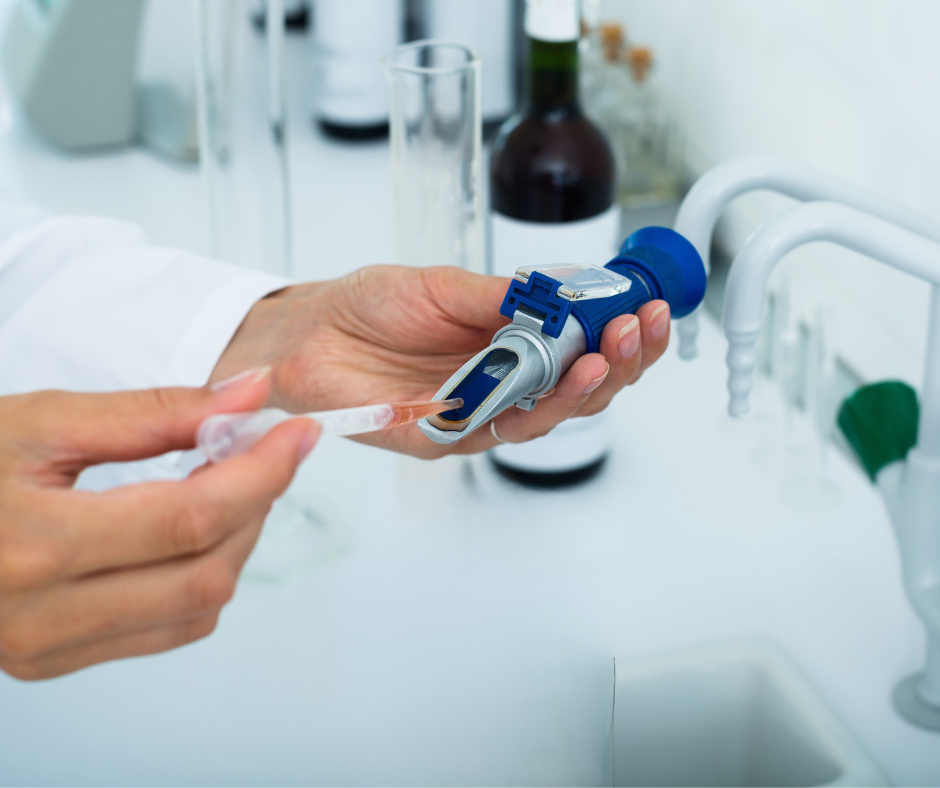
For winemakers, °Brix has long been one of the most important tools for deciding when grapes are ready to harvest. It provides a useful indication of sugar concentration and potential alcohol. But research into grape ripening suggests that °Brix alone may not tell the full story. An increase in sugar concentration does not necessarily mean that the berry is still accumulating sugar.
The key is to look at sugar per berry together with berry weight. During early ripening, grapes receive sugars through the phloem while gaining water and increasing in size. Eventually, sugar accumulation reaches a plateau. After that point, the berry may continue losing water, causing °Brix to rise even though the actual amount of sugar per berry remains relatively stable.
This concept, known as berry sugar loading, offers winemakers another way to understand ripening. Studies on Shiraz and Cabernet Sauvignon show that the sugar-accumulation plateau can serve as a physiological reference point. Rather than relying on a fixed °Brix target, growers can consider what happens before and after this plateau and relate it to the desired wine style.
What happens after the plateau can be particularly important. Research found a shift in wine aroma from fresh and red-fruit characteristics towards black fruit, plum and riper-fruit profiles. Phenolic development also continues, while tannins become increasingly extractable during winemaking. In some trials, tannin concentrations increased by approximately 25–50% between wines associated with fresher and riper harvest stages.
Climate makes the issue even more relevant. Higher temperatures can bring forward the sugar plateau and shorten the active sugar-accumulation period. Continued water loss can then push °Brix higher, creating a potential gap between potential alcohol and aromatic or phenolic maturity. This is particularly important in warm vintages.
The monitoring approach is relatively straightforward: begin around veraison, take representative samples, measure °Brix and average berry weight, and calculate sugar per berry over consecutive sampling dates. When °Brix rises while sugar per berry remains stable and berry weight falls, increasing concentration is likely being driven largely by water loss.
The sugar plateau does not determine the harvest date on its own. Instead, it provides a physiological reference that can be combined with berry tasting, acidity, tannin extractability, colour, sanitary condition and the desired wine style.
Ultimately, the question for the modern winemaker is no longer simply, “How many degrees has the grape reached?” It is also: “Is the berry still accumulating sugar, or is it becoming more concentrated because it is losing water and where are we in its aromatic and phenolic development?”
Reference:


